Is AI Moral? | Data With Duke Season 0 Episode 1
In this special live debate crossover with Frontal Plays, we tackle one of the most contentious questions of the modern digital age: Is using Artificial Intelligence immoral? From TikTok apology culture and copyright theft claims to environmental footprints, job displacement, and social media virtue signalling, Frontal and Duke break down the ethics, economics, and human psychology behind AI adoption. Are we witnessing a moral crisis, or just another historical fear of technology?
Watch the video on YouTube
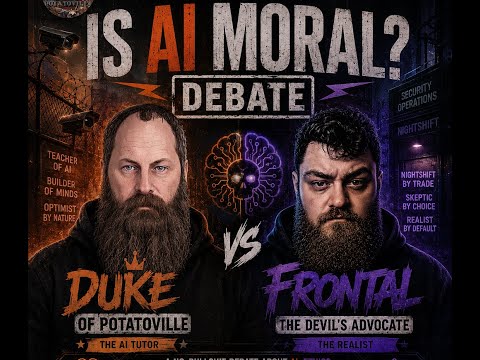
Special Episode – Is AI Moral?
Show Notes (with AI assistance)
Welcome to a special edition of Data with Duke! In this episode, Duke joins forces with host Frontal Plays for a live, unvarnished debate on the cultural taboo surrounding artificial intelligence. If you’ve spent any time on social media recently, you’ve likely seen the outrage: creators apologising for using AI graphics, accusations of “stolen work,” and “Made Without AI” badges treated like digital badges of honor.
But where does genuine ethical concern end and performative posturing begin?In this back-and-forth debate, Frontal brings the real-world worries, pushbacks, and critical questions facing creators and everyday workers, while Duke comes armed with history, cognitive science, and data to advocate for the tool.
Here is what went down in the arena.
Segment 1: Setting the Scene — Why does using AI make people feel guilty?
Frontal’s Question: Why do creators feel morally obligated to apologise for using AI graphics, when nobody apologises for driving a car, using Google, or running spellcheck?
Duke’s Defense (The Anthropomorphic Trap): Guilt stems from an evolutionary quirk known as the Anthropomorphic Trap (rooted in Hyperactive Agency Detection). Our brains evolved to see intent and life where there is none—like assuming a rustle in the bushes is a tiger.Because Large Language Models converse like human beings, our brains trick us into thinking we are interacting with a conscious mind (or “cheating” off a professor) rather than using a complex calculator. The Stigma: While academic institutions are slowly adapting to AI citation, social media has built a cancel culture taboo around it.
Segment 2: The Sustainability Debate — Is AI burning the planet?
Frontal’s Counter: What about the massive energy footprint and environmental impact? People feel using an AI prompt is actively burning down forests or wasting precious water.
Duke’s Defense (Spending Megawatts to Save Gigawatts): The Data: The International Energy Agency (IEA) projects data center electricity consumption could reach 945 Terawatt-hours by 2030. The power and water demands are real and require strict management. The Reality: Myths about water being “ruined” by data centers are false - water is recycled in closed-loop cooling systems. The Net Benefit: Machine learning frameworks integrated into weather forecasting and national power grids are massively increasing energy efficiency. We are spending extra megawatts in compute to prevent gigawatts of systemic energy waste.
Segment 3: The Hypocrisy Debate — Photoshop, Calculators & History
Frontal’s Point: Take Photoshop or automated design tools. You can do the work of someone with 10 years of experience in minutes. Is AI replacing human labor or improving it?
Duke’s Defense (The Loom-Smashing Reflex): Adobe’s entire suite is now powered by AI. Drawing an arbitrary moral line at the tool you grew up with while demonising new tools is historical amnesia. In the 1830s, artists protested photography as “the death of painting.” In the 1970s, teachers campaigned to ban handheld calculators. In the 19th century, the Luddites smashed mechanical looms. Society routinely mistakes mechanical efficiency for a moral failing.
Segment 4: Is AI Theft? — Transformer Math vs. Copyright
Frontal’s Question: AI was built using web crawlers sucking in millions of images and books without permission. If I download Disney movies and redistribute them, that’s theft. Where does AI sit?
Duke’s Defense (Inspiration vs. Plagiarism): How LLMs Actually Work: Neural networks are not giant databases storing copyrighted JPEGs or text files to collage together. AI uses transformer architecture to convert data into abstract mathematical weights, patterns, and metadata, discarding the source files. The Art Student Parallel: If a human spends four years in a gallery studying Picasso to learn style patterns, we call it education. When a machine analyzes pixel patterns to learn style rules, calling it “theft” misunderstands copyright law (which protects literal expression, not abstract concepts). Legal Landscape: Referencing recent US court rulings (such as Bartz v. Anthropic) where courts affirmed that training models on public texts constitutes fair, transformative learning.
Segment 5: The Working Class Perspective — Democratization vs. Job Loss
Frontal’s Pushback: What about the working-class artist selling Twitch overlays or NHS receptionists being replaced by automated triage bots? Aren’t corporate executives the only ones profiting while everyday people lose jobs?
Duke’s Defense (Job Shift & Cognitive Equalization): Historical Job Metamorphosis: Technology causes a job shift, not total elimination. Plato complained that the invention of writing destroyed the livelihoods of oral heralds; the printing press disrupted scribes.Banning AI is Elitist: Restricting AI doesn’t stop rich corporations (who can afford massive human teams). It hurts the NHS security worker or single parent trying to run a side-hustle after a 12-hour shift.AI acts as a cognitive prosthetic for neurodivergent individuals and disabled creators, lowering the barrier to technical skills.
Segment 6: AI and Creativity — Process, Outcome & “AI Slop”
Frontal’s Angle: Does easy creation cheapen art? What about the flood of low-effort “AI Slop” flooding YouTube and social feeds?
Duke’s Defense (The Duchamp Readymade Pivot): What is Art? In 1917, Marcel Duchamp put a commercial urinal in an art gallery (Fountain). Art resides in human intention, curation, and framing, not physical suffering. AI shifts the creator from a draftsman to an art director (like Steven Spielberg directing a film crew).
“AI Slop”: Low-effort synthetic videos (e.g., karaoke-singing cats) are a distribution and algorithm problem, not a technical flaw. Social platforms reward engagement loops, flooding feeds with spam.The Counter-Weight: The exact same deep-learning frameworks generating silly memes are powering AlphaFold 3, predicting molecular structures to cure diseases.
Segment 7: Social Media Virtue Signalling — The New Digital Taboo
Frontal’s Point: Platforms now automatically tag uploaded content as “Made with AI,” making creators fearful of public callouts.
Duke’s Defense (Performative Outrage & Organic Branding): “Made Without AI” badges have become the new “100% Organic” luxury branding—a way to signal moral superiority while changing nothing. The Witch Hunt: Online callout culture has gotten so toxic that traditional human artists are routinely harassed and driven off TikTok simply because their painting style looks “too clean. “The Hypocrisy: Users broadcasting anti-AI outrage on TikTok or X are using apps powered by massive machine-learning recommendation algorithms.
Segment 8: The Future, Recruitment & Essential Skills
Frontal’s Concern: HR recruitment is a nightmare with AI-written CVs competing against AI filtering systems. Customer support has been gutted by frustrating, useless chatbots.
Duke’s Perspective (Human-in-the-Lead): The AI Detector Myth: AI text detectors are mathematically flawed and functionally useless against modern LLMs. Institutions like Vanderbilt University have completely abandoned them. Market Corrections: Companies replacing all human customer support with bad AI bots will lose customers to competitors, forcing a return to “human-in-the-lead” workflows. The Two Essential Future Skills: Data Literacy: Understanding what data to gather, how to analyze it, and making informed decisions. Critical Thinking: Learning to question instructions, analyze intent, and evaluate outcomes rather than blindly following algorithmic output.
Key Quotes of the Episode
- “You aren’t cheating a human; you’re just using a better calculator.” — Duke (On the Anthropomorphic Trap)
- “If creativity is defined entirely by how much you suffer during physical execution, then a hand-shoveled trench is more valuable than a designed skyscraper.” — Duke
- (On Duchamp & AI Art) “Alan Kay famously said: ‘The best way to predict the future is to invent it.’ Peter Cheese updated that for our generation: ‘The best way to predict the future is to help shape it.’ If we run away from AI out of guilt, we abandon the steering wheel.” — Duke
References & Recommended Reading
The Anthropomorphic Trap & Media Equation:
- Reeves, B., & Nass, C. (1996).
- The Media Equation: How People Treat Computers, Television, and New Media Like Real People and Places.Barrett, J. L. (2000).
- Exploring the Natural Foundations of Religion (Cognitive basis for HADD).
Art History & Readymades:
- Tomkins, C. (1996).
- Duchamp: A Biography (Analysis of Fountain, 1917).
- Baudelaire, C. (1859).The Modern Public and Photography.
Legal & Technical Precedents:US Federal Court Precedent:
- Bartz v. Anthropic (Fair Use in LLM training models).
- International Energy Agency (IEA): Digitalization and Energy Transitions Framework (945 TWh Projections).
- Future of Work & Productivity:Kay, A. (1971).
- Xerox PARC Dynabook Research Notes.Cheese, P. (2024).
- CIPD Leadership Framework on AI and Workforce Strategy.